
How can a place with so many pretty trees hold so many bad memories? – Lilian
This is a post about the Dachau concentration camp. Trigger warning: this post is about horrors and atrocities.
Today, we learned about the vegetation at Dachau, the nazi’s first and longest running concentration camp. Some of the trees are there because that’s where they happened to grow. Some of the trees are there because survivors and family members wanted a peaceful place where they could mourn. And some of the trees are there because they were used for nazi propaganda.
Dachau is a lot to take in, both figuratively and literally. At the beginning of our tour, our guide asked us to think about whether it was bigger or smaller than we’d pictured. Everyone said “bigger.” I think our human brains can’t comprehend the enormity of the human suffering that was perpetrated there. We have to scale it down in our imaginations.
We began our tour outside the camp gates. Here we saw the buildings that housed the SS men and their families. This part of the camp isn’t open to the public, because it was repurposed for the 1972 Munich Olympics. They put up police and security there. Even with a limited view over the fence, we could see that it looked like a nice place to live. Stark contrast to the living conditions just across the way (past the ditches and barbed-wire fencing). A lot of men chose to join the SS out of pure, old-fashioned greed. It gave them opportunities that would normally have been unavailable to them due to their class, educational level, etc. There’s something extra horrifying about the idea of perpetrating atrocities because you want a nicer house and a bigger paycheck.
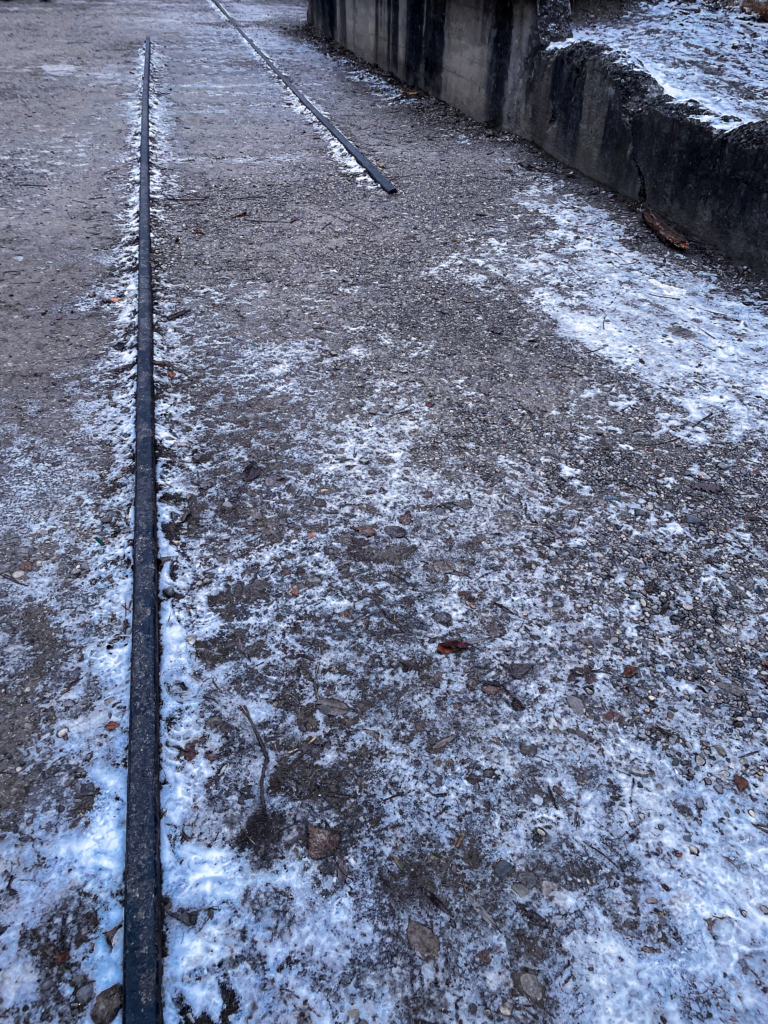
Most of us think of prisoners being transported in trains right up to the gates of concentration camps. There are track remnants outside Dachau and prisoners were transported there by rail. But many of them were brought to the town center by train and then force-marched the 45 minute walk to the camp. Local residents could see exactly what was going on (especially towards the end, when people were brought there from other camps). Some townspeople gave the prisoners food and water. But, many of them spit on their fellow humans and called them names.
Twice a day, everyone had to stand at attention in the “roll call area” in front of the barracks so that they could be counted. Our guide showed us a picture (painted by a survivor) of the thousands of prisoners, held at bay by just a handful of officers. She asked us why they didn’t join together and rebel. The first words that came out of my mouth were, “because they were starving.” She also pointed out the towers where guards were sitting with guns, just waiting to get that extra paid holiday for shooting someone who tried to escape. Oh, and the electrified barbed wire fence.
But, as we walked further into the camp, the image that stuck in my mind was that 45 minute walk from a town where they’d been jeered at and spit on. Camp conditions were literally designed to be soul-crushing. But, even if you wanted to brave the bullets and the barbed wire, what does it do to your psyche to know that people living nearby would turn you in with no hesitation? Fascism thrives with access to guns and billy clubs. But it also thrives when ordinary people turn away from their own humanity.
The grounds around the two crematoria are peaceful and lovely. Well, as lovely as grounds can be when it’s below freezing and icy. They’ve been cultivated to be a place that’s conducive to quiet contemplation. Walking around that area feels like wandering in a cemetery. Because, that’s basically what it is. This is a place where they burned human bodies and then dumped the ashes on the floor. When they ran out of capacity (because their passive killing machine was “passively” killing hundreds of people a day), they built more ovens. And then, when they ran out of coals, they stacked the bodies outside.
When the Allied forces liberated the camp, they took as many photos and videos as possible. And, because they didn’t want to let anybody look away, they marched as many locals as possible through the camp to make them bear witness. They forced members of the local nazi party to assist with the burials.
The barracks have all been torn down, but they’ve built two replicas. Each section is built in the style of a different time period. As you walk through, you see the beds get smaller and the (tiny) amenities get worse. When the camp first opened, prisoners had shelves for their (meager) possessions and at least a little bit of elbow room. At the end, they were stacked in bunks like firewood.
The walkway through the barracks is lined with beautiful, tall trees. They’re replicas now, but there were similar trees when the camp was open. They had flowers planted around them. Another section of the camp featured an “herb garden” and a flower store.
I think what really moved me today was the cold. We were only outside for a couple of hours, but by the end of our visit, I felt like my bone marrow had frozen. It was the kind of cold that makes everything feel sore and tender. The kind of cold that turns the wind into a dagger. The kind of cold that makes you wonder if you’ll ever feel warm again. Even with all of our layers, that cold hurt. And then you picture prisoners standing out in that cold for hours at a time, forced to stand at attention as they’re counted. People who are so malnourished you can see their bones. Human beings who are out in that cold wearing thin uniforms and ill-fitting wooden shoes. Guards would throw cold water on them for the hell of it. I washed my hands in the visitors center afterwards and felt like a little baby for how the cold water made me feel.
The day after Dachau was liberated in 1945, it snowed. It was April. You know it was a cold winter when it snows in April.
According to my watch, I walked over five miles today. Some of that is the European lifestyle, but much of it is from walking around the memorial site. Dachau is enormous. And they made the prisoners walk all over it, with nothing but “soup” (water with a few vegetables) in their bellies. Many of them had to perform tasks like shoveling sand from one side of the courtyard to the other…. and then, when they were finished, shoveling it all back.
I hope that some of what I’ve written has given you a feel for what today’s experience was like. It’s not my normal breezy style, but I felt like it was important to share a little bit of what we learned. I would like to give virtual thanks to our tour guide (I gave her thanks in person as well). Most of the little details in today’s post are from her.
I just listened to this podcast, where Ed Helms and Rachel Maddow talked about the lessons from history that we never seem to learn. I’d like to think that looking history straight in the eye might make those lessons stick, at least a little bit. Thank you for reading this.

Thank you for bearing witness.